Menu
Navigate your
writing journey
Learn how to successfully publish your book.
Learn how to successfully publish your book.
Learn what mood is and how it’s created through helpful exercises and examples from classic and contemporary literature.
June 26th, 2025
Read post...
A literary 'hook' in a story promises intrigue, entertainment and answers to the questions it raises. Far from the trickery of a bait and switch, a hook gives a true sense of what your reader can expect of your story's pleasures. Explore great story hook examples and what they teach us about sta...
June 26th, 2025
Read post...
Discover how to create a fantasy world with step-by-step instructions, tips, and fantasy world examples from literature.
June 24th, 2025
Read post...
Are you looking for the best app to write a novel? We've compared 26 apps. Discover the best writing apps for authors to help you plot, write, edit, and format your book.
June 24th, 2025
Read post...
Suspense refers to both genre and a storytelling device that creates tension and builds your reader's desire to find out. Read suspense writing examples, learn suspense-adding story devices you can use, and what experts at creating suspense say. What is suspense? Suspense (defined by Oxfor...
June 23rd, 2025
Read post...
Think of your favorite fictional character, and try to describe why you like them in just a few words. Maybe they’re strong, friendly, and wise; or perhaps they’re honest, resourceful, and passionate — no matter what combination of characteristics it is, odds are you've identified something fundamental that makes their personality compelling.
June 23rd, 2025
Read post...
Learn how to improve your writing skills with practical tips on planning, style, editing, and storytelling.
June 20th, 2025
Read post...
Explore 8 setting examples from recent fiction – from magical libraries to Martian deserts – and learn how to craft immersive, powerful settings in your own stories.
June 13th, 2025
Read post...
Finding the right adjectives for description is tough. Try these 7 tips, and create your own describing word dictionary: What is an adjective? Adjectives are parts of speech used to modify nouns. They describe and make people and things more specific. How do you identify an adjective? ...
June 11th, 2025
Read post...
Clichés can set readers on high alert — making them question the author's ability and imagination and pulling them out of the story. But what are some examples, and how can you avoid them in your writing?
June 11th, 2025
Read post...
Perspective writing is an aspect of narration many writers struggle with. Yet point of view is an important element of storytelling. Read a complete guide to point of view including first person, second and third, plus objective point of view, with definitions and examples: Contents of this P...
June 11th, 2025
Read post...Find the perfect editor for your next book
Over 1 million authors trust the professionals on Reedsy. Come meet them.
Try the ultimate app for planning
Find 40+ templates to structure your story, create characters, and more in Reedsy Studio.

Redirecting you to our sister website...
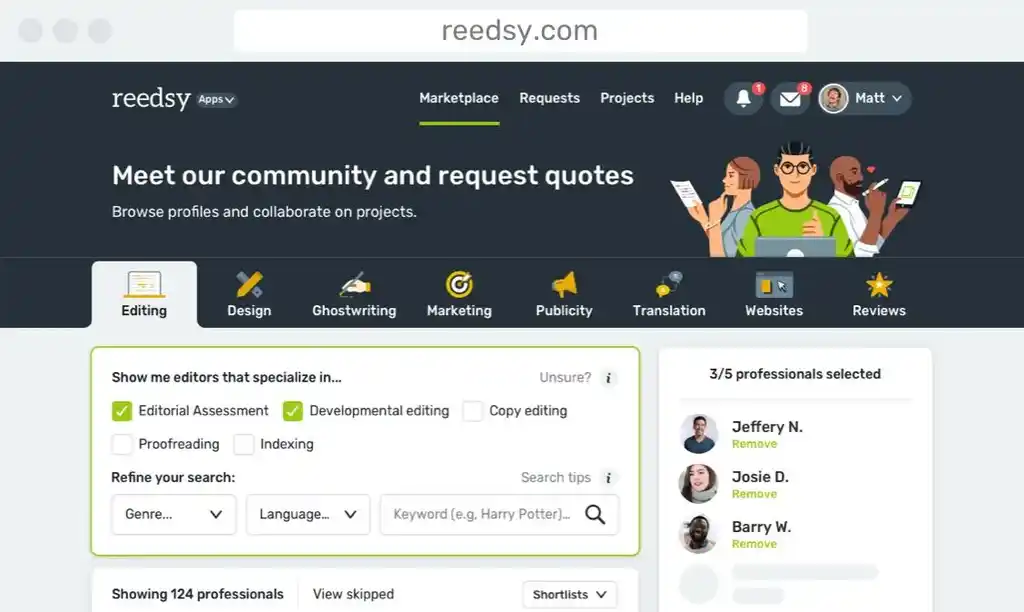
Create your account and request free quotes.